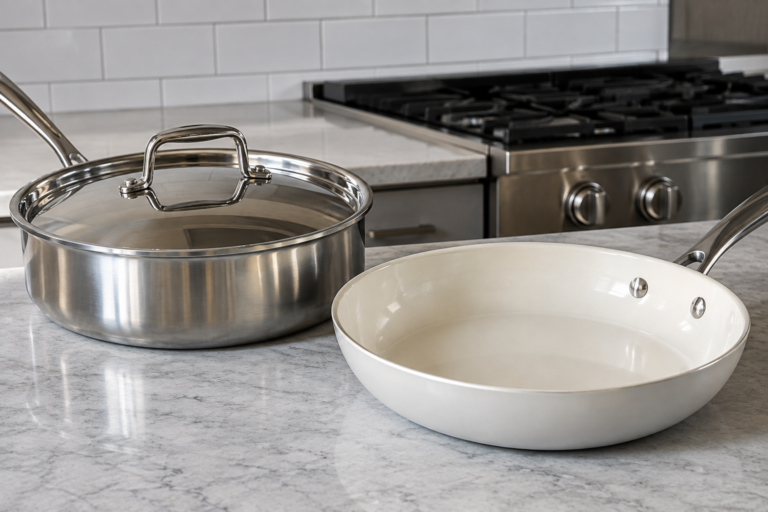
Stainless Steel vs Ceramic Cookware: Which Is Better?
Compare stainless steel and ceramic cookware for food release, high-heat cooking, durability, cleaning, coatings, and long-term value.
KITCHEN SWAPS
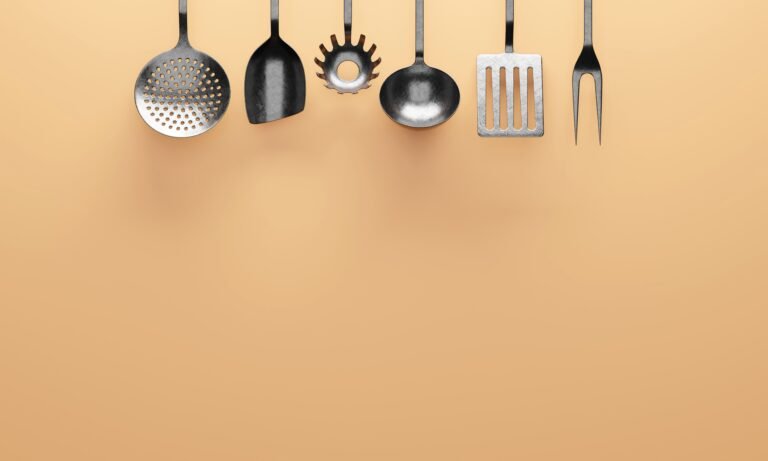
Most Kitchens Need Five Stainless Steel Tools:
A turner, spoon, tongs, ladle, and whisk.
This guide separates utensils made entirely from stainless steel from those that use stainless steel only on the parts that touch food. Both can be good options, but they feel different in your hand and are worth comparing separately.
This post contains affiliate links. If you make a purchase through these links. As an Amazon Associate, I could earn from qualifying purchases at no extra cost to you.
| Product | Best For | Food-Contact Material | Handle Material | Dishwasher Safe |
|---|---|---|---|---|
| All-Clad 6-Piece Cook & Serve Set | A coordinated set | Stainless steel | Stainless steel | Yes |
| OXO Stainless Steel Turner | Flipping and lifting | Stainless steel | Soft non-slip grip | Yes |
| Winco UT-12HT Tongs | Turning and tossing | Stainless steel | Stainless steel | Yes |
| Cuisinart Stainless Steel Solid Spoon | Stirring and serving | Stainless steel | Stainless steel | Yes |
| Norpro 1133 Soup Ladle | Soups, beans, and sauces | Stainless steel | Stainless steel | Yes |
| Rösle 10.6-Inch Egg Whisk | Eggs, cream, and sauces | 18/10 stainless steel | 18/10 stainless steel | Yes |
Fastest Decision: Choose the All-Clad set if you are replacing most of your utensils. If you already own a few keepers, fill only the gaps with the strongest individual tool for each job.
Affiliate Links
HOW I CHOSE
I did not treat every utensil with a silver-colored handle as all-stainless, and I did not add a budget set simply to make the list longer. I also have not personally tested every tool here; these picks are based on manufacturer documentation, listing verification, and practical usefulness.
01 / BEST SET
Affiliate Links
This is one of those rare utensil sets that sticks to the basics. You get a solid spoon, slotted spoon, ladle, fork, tongs, and a countertop caddy without extra gadgets thrown in just to make the piece count look bigger.
All-Clad uses heavy-gauge stainless steel throughout, with 9.5-inch tools that are dishwasher-safe and heat-resistant up to 600°F. That makes this the clearest all-stainless option in the guide and a good match for stainless steel, cast iron, and carbon steel cookware.
Drawbacks: It’s much more expensive than picking up one or two OXO tools, the stainless steel handles can get hot, and the set doesn’t include a whisk or a wide turner.
Best for: Anyone starting from scratch or setting up a new kitchen.
Who should skip it: Anyone who already has a few utensils they like or mostly cooks with coated pans.
02 / BEST TURNER
Affiliate Link
A broad, perforated turner handles the jobs a spoon can’t, from flipping burgers and fish to lifting roasted vegetables while letting excess oil drain away. OXO pairs the stainless steel head with a cushioned, non-slip handle, which can be more comfortable to hold than bare metal.
Drawbacks: The cushioned handle means this isn’t an all-stainless utensil, and the metal edge can scratch or mark ceramic and traditional nonstick coatings.
Best for: Cooking with stainless steel and cast iron skillets.
Who should skip it: Anyone who mostly cooks with coated pans that can be damaged by metal utensils.
Affiliate Link
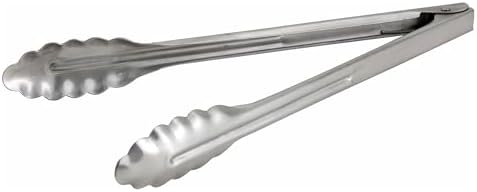
Winco’s extra-heavyweight utility tongs are a straightforward restaurant-supply option. They’re made from 1.2 mm stainless steel with a strong coiled spring and scalloped ends that grip everything from vegetables and chicken to food being served at the table, without a lot of extra parts to deal with.
The catch: There’s no locking ring, so the tongs stay open in the drawer, and the bare stainless steel handles aren’t as comfortable as OXO’s cushioned grip.
Best for: Turning food on the stovetop, tossing ingredients, and serving.
Skip it if: You want a cushioned handle, locking mechanism, or silicone tips for coated cookware.
04 / BEST COOKING SPOON
Affiliate Link
Cuisinart’s polished stainless steel solid spoon is sturdy enough for stirring vegetables, grains, and thick sauces, yet presentable enough for serving at the table. Cuisinart confirms stainless steel construction and dishwasher-safe care, keeping the material story and cleanup straightforward.
The catch: The long, polished handle can feel slick with wet hands, and the rigid bowl is not meant for delicate coatings.
Best for: Sauces, grains, vegetables, and serving.
Skip it if: You mostly use ceramic or nonstick cookware.
05 / BEST LADLE
Affiliate Link
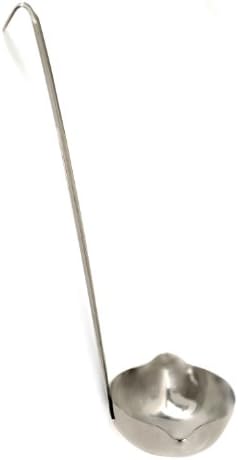
Norpro’s 12.5-inch soup ladle has the reach and depth you want when serving from a deeper pot. Made from stainless steel, it’s a simple, sturdy tool for scooping soups, stews, beans, punch, and other liquid-heavy dishes without feeling undersized.
The catch: The handle doesn’t have a cushioned grip or pouring spout, and the ladle is a little too bulky for small gravy boats or condiment bowls.
Best for: Soups, beans, punch, and pan sauces.
Skip it if: You rarely make soups or other liquid-heavy dishes.
Affiliate Link
Rösle’s 10.6-inch egg whisk has widely spaced fine wires and a slim, rounded handle that works well for whisking eggs, pancake batter, cream, sauces, and soups. It’s made from 18/10 stainless steel, is dishwasher-safe, and Rösle lists it as heat-resistant up to 500°F (260°C).
The catch: The slim metal handle isn’t as comfortable as a cushioned grip, and the wire head can scratch delicate cookware coatings.
Best for: Eggs, baking, sauces, and emulsions.
Skip it if: You mostly use nonstick cookware and need a silicone-coated whisk.
Start with the job, not the bundle size. These five cover nearly every ordinary cooking task.
For: Flipping, lifting, scraping browned bits.
Buy first if: You cook in skillets often.
For: Stirring, scooping, serving.
Buy first if: You cook sauces, grains, or vegetables.
For: Turning, tossing, plating.
Buy first if: You cook proteins or sheet-pan dinners.
For: Soups, beans, sauces.
Buy first if: Liquid meals are in regular rotation.
For: Eggs, batters, emulsions.
Buy first if: You bake or make pan sauces.
Product titles often say “stainless steel” even when only the part that touches food is actually metal. That doesn’t necessarily make the description misleading, but it can make very different utensils sound like they’re made the same way. Here’s the simple classification I use.
The food-contact surface, shaft, and handle are all stainless steel. These tools are durable, straightforward, and generally easy to clean. The tradeoff is a harder grip, handles that can get warm, and a little more clatter around the kitchen.
The part that touches food, such as: The turner head, spoon bowl, tong ends, ladle bowl, or whisk wires is stainless steel, while the handle has a softer grip material. These can be more comfortable to hold during longer stirring, whisking, or serving tasks.
Example here: The OXO turner.
You will often see 18/10, 18/8, or 18/0 in stainless product descriptions. The numbers refer broadly to chromium and nickel content: chromium supports corrosion resistance, while nickel influences corrosion resistance and finish. They are useful clues, but they do not tell you whether a turner is well balanced or a whisk is comfortable.
Many reputable utensil brands don’t list a specific stainless steel grade, and that alone isn’t a reason to rule a product out. Look at the overall construction instead, including the thickness, joints, edges, care instructions, and whatever material information the manufacturer provides. For a simple kitchen utensil, those details often matter more in everyday use.
SHOPPING NOTE
Do not over-read the stamp.
A printed 18/10 claim cannot fix a flimsy weld, sharp edge, or uncomfortable handle. Good construction still has to show up in the tool.
Usually Appropriate: Uncoated stainless steel, cast iron, carbon steel, and sturdy grill surfaces. Metal utensils are especially useful when you need to scrape up fond, slide under a good sear, or cook over higher heat.
If you are building out that side of your kitchen, see my best stainless steel cookware without a coating and the broader kitchen cookware materials guide.
Metal edges and whisk wires can scratch coated cookware and may shorten the life of the cooking surface. Check the manufacturer’s utensil recommendations first. If your pan has a coating, silicone or wood is usually the better choice.
Most kitchens work better with a mix of materials. Stainless steel is useful for high heat and scraping, silicone is gentler on coated cookware and reaches into corners, and wood is comfortable to use without scratching delicate surfaces.
| Material | Best at | Watch for | Best cookware match |
|---|---|---|---|
| Stainless steel | Flipping, scraping, browning, high-heat work | Can scratch coatings; bare handles can get hot | Stainless, cast iron, carbon steel |
| Silicone | Flexible scraping and coated-pan care | Heat ratings vary; very soft heads can feel imprecise | Ceramic and nonstick coatings |
| Wood | Comfortable stirring and gentle contact | Usually hand-wash; can stain or absorb odors | Nearly any cookware |
Affiliate Link

Compare stainless steel and ceramic cookware for food release, high-heat cooking, durability, cleaning, coatings, and long-term value.
Compare the best glass food storage containers by lid design, leak resistance, stacking, oven use, and replacement-lid options.
We use cookies to improve your experience on our site. By using our site, you consent to cookies.
Manage your cookie preferences below:
Essential cookies enable basic functions and are necessary for the proper function of the website.
Statistics cookies collect information anonymously. This information helps us understand how visitors use our website.
Google Analytics is a powerful tool that tracks and analyzes website traffic for informed marketing decisions.
Service URL: policies.google.com (opens in a new window)
You can find more information in our Cookie Policy and .