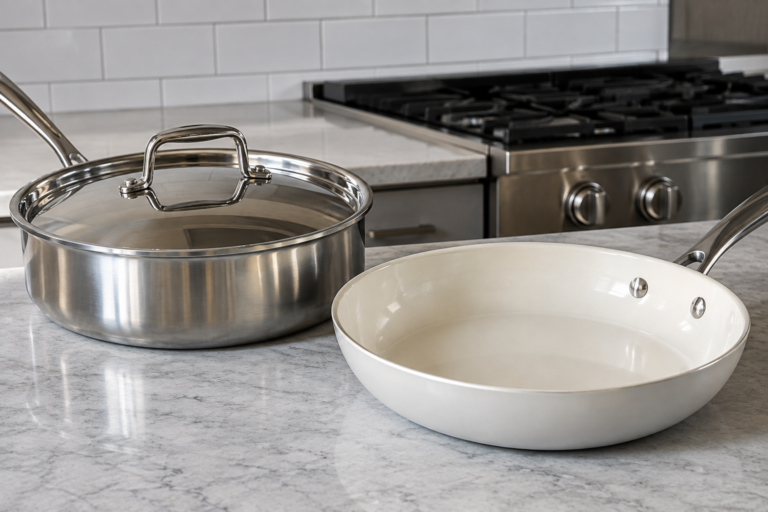
Stainless Steel vs Ceramic Cookware: Which Is Better?
Compare stainless steel and ceramic cookware for food release, high-heat cooking, durability, cleaning, coatings, and long-term value.
Shopping for cookware gets complicated quickly. Stainless steel, cast iron, carbon steel, ceramic, glass, aluminum, and nonstick coatings all behave differently, and labels such as “clean,” “healthy,” and “non-toxic” rarely tell you enough on their own.
For most kitchens, stainless steel is the best all-around cookware material. Cast iron or carbon steel is useful for high-heat cooking, enameled cast iron suits braises and acidic foods, and glass works well for baking. A ceramic-coated or PTFE nonstick pan can make eggs and other delicate foods easier, but any manufactured nonstick coating needs gentler care and will not last forever.
This guide compares the most common kitchen cookware materials, explains what each is best at, and points out the tradeoffs that matter before you buy.
Disclosure: This post contains affiliate links. If you buy through one of these links, I may earn a commission at no extra cost to you. As an Amazon Associate, I earn from qualifying purchases.
| Material | Best for | Cooking surface | Main tradeoff |
|---|---|---|---|
| Stainless steel | Everyday cooking, browning, sauces | Uncoated stainless steel | Food can stick without proper technique |
| Cast iron | Searing, frying, baking | Iron with polymerized oil seasoning | Heavy and needs drying and seasoning |
| Carbon steel | Searing, stir-frying, eggs once seasoned | Steel with polymerized oil seasoning | Can rust and react with long acidic cooks |
| Enameled cast iron | Braises, soups, acidic foods | Vitreous enamel | Heavy; enamel can chip from impact |
| Fully ceramic | Baking and manufacturer-approved stovetop use | Ceramic throughout | Can crack from impact or thermal shock |
| Glass | Baking, casseroles, food storage | Glass throughout | Not usually intended for direct stovetop heat |
| Aluminum | Fast, responsive heating | Bare, anodized, clad, or coated | Performance and care depend on the finish |
| Ceramic-coated | Eggs and delicate foods | Sol-gel nonstick coating over metal | Easy release declines as the coating wears |
| PTFE nonstick | Eggs, pancakes, delicate foods | Fluoropolymer nonstick coating | Requires heat and surface-damage precautions |
Best for: everyday cooking, browning, sautéing, pan sauces, and acidic ingredients.
Stainless steel is durable, does not require seasoning, and works for a wide range of foods. Because stainless steel is not an especially efficient heat conductor on its own, better pans usually bond it to an aluminum or copper layer. That conductive layer helps the pan heat more evenly while stainless steel remains on the cooking surface.
For skillets and sauté pans, fully clad construction is usually the most versatile choice because the conductive layers extend across the base and up the sides. A thick bonded base can still work well for stockpots and other pieces where sidewall heating matters less. Terms such as 3-ply and 5-ply describe the number of bonded layers, but layer count alone does not guarantee better performance.
The main learning curve is sticking. Preheat the pan over moderate heat, add enough fat, and give proteins time to brown and release before trying to flip them. If you are ready to shop, my guide to the best stainless steel cookware without a coating compares sets and individual pans with uncoated food-contact surfaces.
Best for: searing, shallow frying, baking, and recipes that benefit from steady heat.
Cast iron heats more slowly than thin metal cookware but retains heat very well once hot. The cooking surface is typically seasoned with thin layers of oil that have been heated until they form a polymerized layer. That seasoning is different from a factory-applied PTFE or ceramic nonstick coating, although it still needs maintenance.
Bare cast iron can handle brief contact with tomatoes, wine, or citrus when the seasoning is sound. Long acidic cooks can weaken the seasoning or give food a metallic taste, so stainless steel or enameled cast iron is a safer choice for an all-day tomato sauce.
Cast iron is heavy, and it can rust if it is left wet. Hand wash it according to the manufacturer’s instructions, dry it promptly, and apply a very thin layer of oil when needed. For an affordable first skillet, check the current price for the Lodge 10.25-inch skillet on Amazon.
Best for: high-heat cooking, searing, sautéing, stir-frying, and cooks who want something lighter and more responsive than cast iron.
Carbon steel heats and cools faster than cast iron and develops a seasoned cooking surface over time. A well-seasoned carbon steel skillet or wok can release eggs and other foods surprisingly well without a manufactured nonstick coating.
Like bare cast iron, carbon steel needs seasoning and prompt drying to resist rust. Long contact with acidic ingredients can strip seasoning and expose the reactive metal underneath. Many carbon steel pans also arrive with protective wax or oil that must be removed before the first seasoning, so follow the specific maker’s instructions.
Best for: soups, stews, braises, sauces, acidic foods, and dishes that move from stovetop to oven.
Enameled cast iron combines the heat retention of cast iron with a vitreous enamel surface. The enamel does not need the seasoning routine required by bare cast iron and is better suited to long cooks with tomatoes, wine, and other acidic ingredients.
It is heavy, can be slow to respond when you change the burner setting, and costs more than basic bare cast iron. Enamel is durable but not indestructible. Hard impacts, thermal shock, and scraping with utensils the manufacturer does not recommend can chip or damage it. Replace a piece if the interior enamel is badly chipped or the maker advises that it is no longer safe to use.
Best for: people who specifically want a pan or baking dish made from ceramic rather than metal cookware with a ceramic-style coating.
“Ceramic cookware” can describe two very different products. Fully ceramic cookware is ceramic throughout. Ceramic-coated cookware has a metal body covered by a manufactured nonstick layer, often made with a silica-based sol-gel process. The two do not cook or wear in the same way.
Fully ceramic cookware can be more vulnerable to impact and sudden temperature changes than metal cookware. Some pieces are suitable for the stovetop; others are intended only for the oven. Check the manufacturer’s approved heat sources, temperature limit, and preheating instructions for the exact piece.
Best for: casseroles, baking, roasting, and storing leftovers in the same container.
Glass is nonreactive and lets you see browning along the sides and bottom of a dish. It is useful in the oven, microwave, refrigerator, and freezer when the manufacturer approves those uses for the specific product.
Most glass bakeware is not designed for direct stovetop heat. Sudden temperature changes, impact, scratches, and misuse can lead to breakage. Borosilicate and tempered soda-lime glass behave differently, but neither label replaces the care instructions supplied with the dish. Never move a hot glass dish directly onto a wet or cold surface unless the manufacturer explicitly says it is safe.
Best for: quick, responsive heating and even temperature changes.
Aluminum conducts heat well, which is why it appears in so much cookware. The useful question is where the aluminum sits and what actually contacts the food.
In clad stainless cookware, an aluminum core is sealed between stainless steel layers. Hard-anodized aluminum has an electrochemically hardened surface. Other aluminum pans use ceramic or PTFE nonstick coatings. Bare aluminum can react with acidic or salty foods and may discolor, so clad, anodized, or appropriately coated construction is generally easier for everyday use.
Best for: easy release with eggs, fish, pancakes, and other delicate foods.
A ceramic-coated skillet is usually a metal pan with a silica-based sol-gel coating. It can feel impressively slick when new, but that performance generally declines as the surface wears. “Ceramic” alone does not prove that a pan is PFAS-free; look for an explicit statement from the manufacturer about the exact coating.
Use low-to-medium heat, avoid empty preheating, and choose silicone or wood utensils unless the maker says otherwise. Even when a brand advertises metal-utensil compatibility, softer tools usually give the surface a better chance of lasting. If you want a current example, GreenPan says its Thermolon coating is made without intentionally added PFAS and recommends low-to-medium heat. You can view the GreenPan Valencia Pro 10-inch fry pan on Amazon.
Best for: delicate foods when easy release and minimal cleanup matter most.
Traditional nonstick cookware commonly uses PTFE, a fluoropolymer within the broad PFAS family. PFOA is a different PFAS that was historically used in manufacturing. This distinction matters: “PFOA-free” does not mean “PFAS-free” when the cooking surface contains PTFE.
The EPA reports that companies participating in its stewardship program phased PFOA out of their emissions and products by 2015, while noting that some imported articles or products from nonparticipating companies may still contain it. The FDA says authorized polymerized PFAS coatings for nonstick cookware are tightly bound to the pan and show negligible migration to food. You can read the agencies’ current explanations in the EPA PFOA Stewardship Program fact sheet and the FDA’s PFAS-in-food questions and answers.
That does not make care optional. Reserve PTFE pans for low-to-medium heat, do not leave them empty over a hot burner, and follow the manufacturer’s maximum temperature and utensil guidance. Replace a pan when the coating is peeling, flaking, or substantially damaged.
You do not need a large matching set to cover most meals. A compact collection can give each material a job it handles well:
This approach also makes replacement less wasteful. If a coated egg pan wears out, the rest of the collection can stay in service.
I am less concerned with declaring an entire material “bad” than with the condition, construction, and instructions for a specific piece. I would avoid or replace cookware with:
Words such as “eco,” “granite,” “stone,” and “healthy” can be marketing descriptions rather than useful material specifications. If a listing never identifies the cooking surface, keep looking. The same rule applies to broad “non-toxic” claims; my guide to what “non-toxic” means on product labels explains why the details matter more than the headline.
Before replacing everything, check the pieces you already own. Identify the cooking surface, read the care instructions, and retire damaged items one at a time. For a broader approach, see these five practical kitchen swaps. If you use silicone tools with coated pans, this guide to silicone kitchenware safety and quality explains what to look for.
Stainless steel is the best all-around starting point for most kitchens because it is durable, relatively low-maintenance, and suitable for browning, sauces, acidic foods, and oven finishing. Fully clad construction usually gives skillets and sauté pans more even heating.
There is no single safest material for every person and every cooking method. Choose a well-made product from a manufacturer that clearly identifies the cooking surface and care limits, then use it as directed. The condition of the pan, the temperature, and the food being cooked all matter.
Uncoated stainless steel, bare cast iron, carbon steel, glass, and fully ceramic cookware do not use PTFE nonstick cooking surfaces. Enameled cast iron uses a vitreous enamel surface. For ceramic-coated or other manufactured nonstick cookware, verify an explicit PFAS statement for the exact product rather than relying on “PFOA-free” or “ceramic” alone.
No. Fully ceramic cookware is ceramic throughout. Ceramic-coated cookware usually has a metal body with a thin, manufactured sol-gel coating. The coated version offers easier food release at first, while fully ceramic pieces have different heat, impact, and appliance limitations.
No. Aluminum is commonly used as a heat-conductive core inside clad stainless steel cookware and as the body beneath anodized or nonstick surfaces. Construction and the food-contact surface tell you more than the presence of aluminum alone.
Stainless steel does not develop a permanent nonstick coating through normal use. Proper preheating, enough cooking fat, moderate heat, and waiting for food to release after browning can greatly reduce sticking.
Replace cookware when a coating is peeling or flaking, interior enamel is badly chipped, glass or ceramic is cracked, the base is severely warped, a handle is unsafe, or damage exposes material that was not meant to contact food. Follow the manufacturer’s instructions when they are more specific.
The most useful kitchen usually contains a small mix of cookware materials. Stainless steel earns the everyday workhorse role, cast iron and carbon steel handle high heat, enameled cast iron suits slow and acidic cooking, and glass or fully ceramic pieces cover many baking jobs. Coated pans can make delicate foods easier, but their temperature limits and finite lifespan belong in the buying decision.
Pay attention to the actual cooking surface, construction, condition, and intended use. Your cookware does not need a dramatic wellness claim. It needs to suit the food you cook and hold up to the way you use it.
Compare stainless steel and ceramic cookware for food release, high-heat cooking, durability, cleaning, coatings, and long-term value.
Compare six stainless steel cooking utensils, including a practical set and the five tools most kitchens actually need.
We use cookies to improve your experience on our site. By using our site, you consent to cookies.
Manage your cookie preferences below:
Essential cookies enable basic functions and are necessary for the proper function of the website.
Statistics cookies collect information anonymously. This information helps us understand how visitors use our website.
Google Analytics is a powerful tool that tracks and analyzes website traffic for informed marketing decisions.
Service URL: policies.google.com (opens in a new window)
You can find more information in our Cookie Policy and .